You might have landed here wondering how UPI charges are changing from 15 October 2026.
Since India has gone digital, UPI has become the most convenient way to pay. We’ve all stopped carrying much cash and now depend on UPI for almost every payment. With news going around that UPI payments to merchants above ₹2,000 will no longer be free, you need to get clarity on one important thing first: these charges won’t apply to all of us. The changes concern the Merchant Discount Rate (MDR) on certain merchant transactions.
We understand that the rules arrived all of a sudden and sound confusing to many of you. So, let’s go through them in the simplest way.
What is MDR?
MDR stands for Merchant Discount Rate. It’s a small cut a business pays whenever it receives a payment. UPI has run with zero MDR since January 2020, and from 15 October a limited set of merchant payments will carry one.
What do the rules mean for regular users?
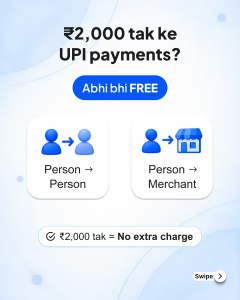
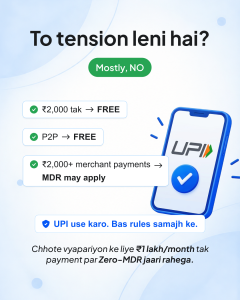
- When you send money to another person (a P2P, or Person-to-Person, transaction), there is no charge at all.
- A merchant payment of up to ₹2,000 also carries no MDR.
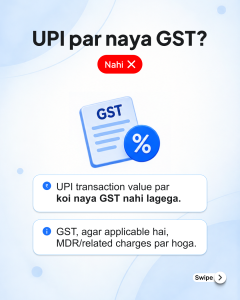
- Even if you pay a merchant more than ₹2,000 (a P2M, or Person-to-Merchant, transaction), you still won’t be charged anything.
So as a regular user, you won’t be charged for UPI payments, whether P2P or P2M.
Where does the charge kick in?
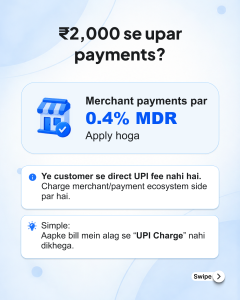
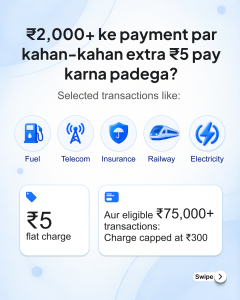
The new rate is 0.4% on eligible merchant payments above ₹2,000, capped at ₹300 per transaction. The cap applies from ₹75,000 onwards. So if a merchant receives ₹10,000, the MDR is ₹40. For ₹5,000, it’s ₹20.
Again, that’s charged on the merchant’s side. Whether some shops respond by nudging customers toward cash on big bills is something to watch, but nothing in the rules asks you to pay it.
Which sectors get a flat ₹5?
A few essential sectors don’t use the 0.4% rate. These include fuel, railways, insurance, telecom and agricultural inputs. For transactions above ₹2,000 in these sectors, a flat ₹5 MDR applies.
What about stocks and mutual funds?
Capital market payments have their own rate: 0.02%, capped at ₹300, on payments above ₹2,000. That covers payments to mutual funds, securities, stockbrokers and dealers. A ₹50,000 payment works out to just ₹10. This is a charge on the receiving side, such as the broker or fund house, and is not added to your payment. SIPs that run through UPI AutoPay aren’t charged at all.
What about small merchants?
There is some relief here. Small shops, local businesses and street vendors who receive up to ₹1 lakh per month through UPI QR will continue to have zero MDR under the small-merchant framework.
Should you worry about UPI becoming expensive?
The takeaway is that UPI isn’t becoming expensive the way many headlines make it sound.
P2P payments remain free. UPI merchant payments up to ₹2,000 remain free. Eligible small merchants continue with zero MDR.
The important change is the MDR structure for specific merchant payments above ₹2,000 from 15 October 2026.
So the next time you hear that “UPI charges are starting,” don’t take it as a charge on every UPI payment. The type of transaction, its value, and the merchant category all matter.
Here are the visual pointers regarding UPI Charges From 15 October 2026: